Monkeg Typeface: A Modern Display Font for Memorable Branding
Last Tuesday, I helped a local candle maker update her jar labels — the kind customers hold in their hands, turn over, and pause at. She’d been using a free font that looked “fine” on screen but felt flat and forgettable in print. When we swapped it out for Monkeg, something shifted instantly: the curvy, wave-like letterforms gave her brand warmth and rhythm — like the gentle flicker of flame itself. That’s the quiet power of a well-chosen display font: it doesn’t just say what you sell; it makes people *feel* why they should care.
Monkeg for Handmade Product Labels and Small-Batch Packaging
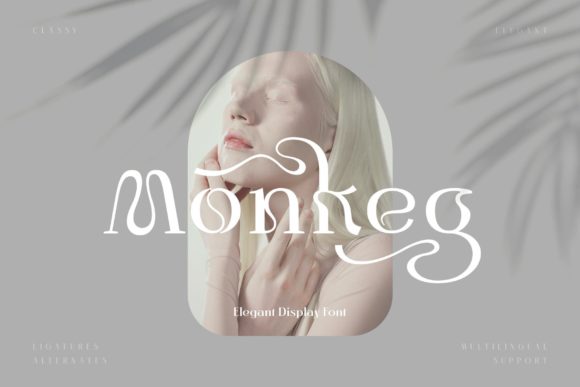
Monkeg is a modern display font built for moments where your product meets a person — not on a spreadsheet or a spec sheet, but in real life. Its defining trait? That soft, undulating shape — like ripples across water or the smooth curve of hand-poured wax. It’s charming without being cutesy, unique without being distracting. For small-batch makers — think candle jars, skincare dropper bottles, tea tins, or ceramic tags — Monkeg works beautifully as a title or short descriptor (e.g., “Lavender & Sea Salt” or “Small Batch • Hand Poured”). Because it’s a display font, it shines at larger sizes: 24pt+ on printed labels, 36pt+ on front-of-jar branding. Just avoid cramming it into tiny ingredient lists — that’s where a clean sans serif companion steps in.
Monkeg for Café Menus, Bakery Boxes, and Local Shop Signage
I’ve seen Monkeg transform café menus twice this month — once for a neighborhood bakery wrapping sourdough loaves in kraft paper, once for a third-wave coffee counter updating their chalkboard-style digital menu. In both cases, Monkeg was used for section headers (“Sourdough • Brioche • Rye”) and featured item names (“Honey-Cardamom Loaf”). Why it worked: its organic flow mirrors the handmade, human-centered vibe these businesses cultivate. It’s legible from 3 feet away (tested on matte laminated menu boards), holds up beautifully when laser-cut into wood signs, and adds subtle elegance to brown paper bags stamped with ink. As a display font, it’s never meant to carry long paragraphs — but for those key, glanceable moments? It builds instant recognition.
Monkeg for Instagram Templates, Digital Ads, and Social Media Branding
Scrolling through Instagram Reels or Pinterest pins, first impressions happen in under two seconds. That’s where Monkeg earns its keep as a premium font for social graphics. Its PUA-encoded structure means every alternate character, swash, and ligature loads reliably — no missing glyphs when you export a Canva template or upload a Shopify banner. I recently used Monkeg for a boutique’s seasonal sale banner (“Summer Edit • Now Live”) and watched engagement lift noticeably on Stories — not because of copy changes, but because the font added visual texture and intention. Pair it with a neutral sans serif (like Inter or Montserrat) for body text, and you’ve got a system that feels curated, not cluttered.
Monkeg for Thank-You Cards, Stickers, and Customer-Facing Print Collateral
Here’s what surprised me most: how well Monkeg translates to tactile materials. We printed thank-you cards on thick cotton stock, used it for die-cut stickers on apothecary jars, and even tested it on fabric care tags for a slow-fashion brand. The curves soften the formality of print — making “Thank You” feel personal, not transactional. Because Monkeg is PUA encoded, special characters (like custom ampersands or floral-inspired alternates) stay intact across platforms — critical when designing assets for clients or selling printable templates. Just remember: always check the included file formats (OTF/TTF/WOFF) and confirm commercial licensing covers physical products — especially if you’re applying Monkeg to merchandise, packaging, or client deliverables.
Monkeg for Logo Design and Standalone Brand Marks
Can you build a logo with Monkeg? Yes — but thoughtfully. Its personality is strong, so it works best for brands whose voice is warm, approachable, and quietly confident (think botanical skincare, artisan ceramics, mindful coaching, or coastal homeware). Avoid pairing it with overly rigid geometric fonts — instead, try it with a relaxed serif (like Playfair Display) or a grounded sans (like Manrope) for balance. One caveat: since Monkeg is a display font, it’s ideal for wordmarks or monogram accents — not long taglines or stacked legal disclaimers. And always test at thumbnail size: does “Monkeg” still read clearly at 80px wide on a mobile shop banner? If yes, you’ve found a keeper.
At its core, Monkeg isn’t just another font download — it’s a consistency tool. When your candle label, Instagram highlight cover, and receipt stamp all share that same gentle wave, customers begin to recognize your brand before they even see your name. That’s the value of choosing a purpose-built display font: less noise, more nuance. More you.